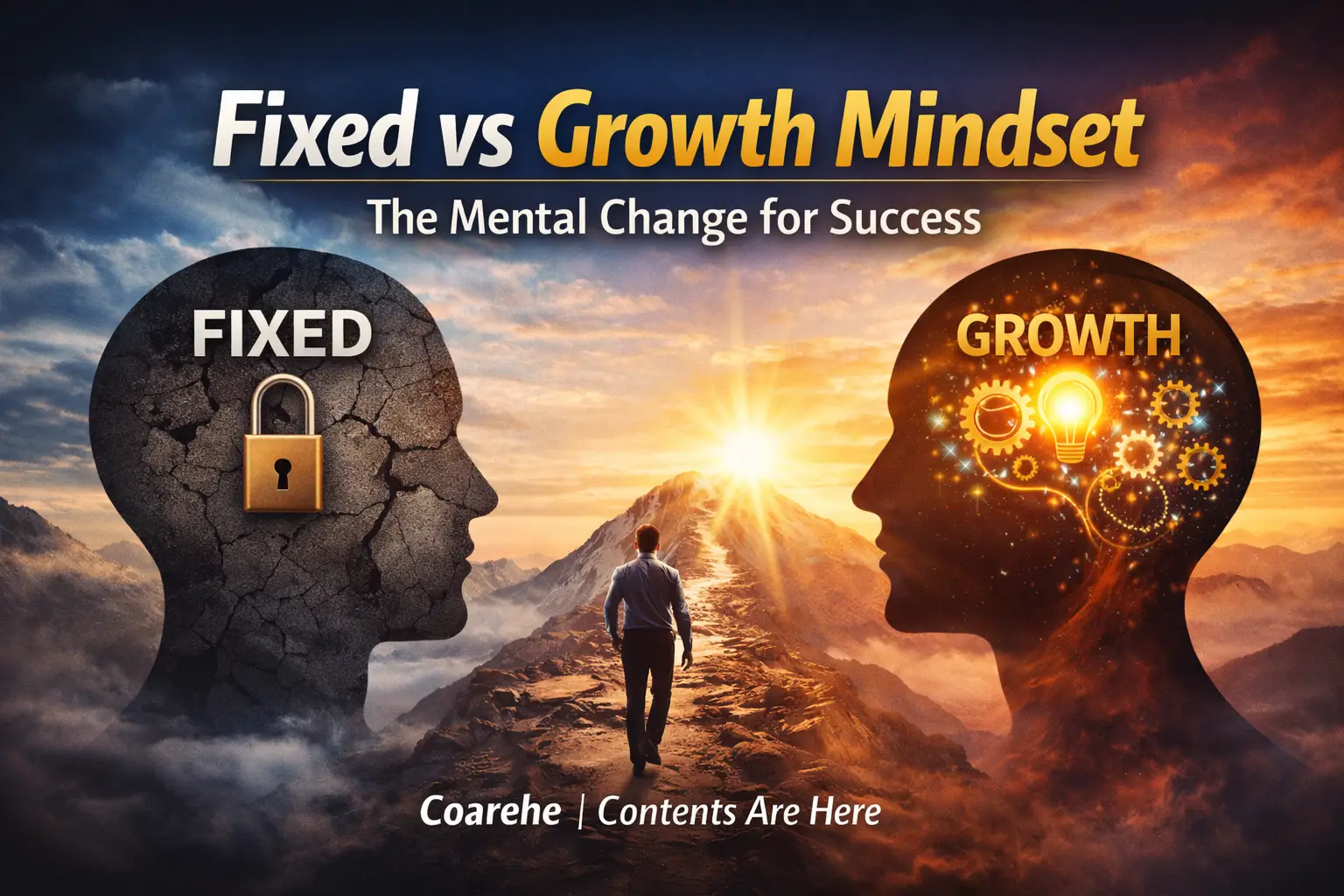

Success rarely starts with talent. Instead, it begins with how you think about talent. Many people search for better habits, stronger motivation, or smarter strategies. However, the true breakthrough often begins deeper in the mind.
This is where the concept of fixed vs growth mindset becomes powerful.
Your mindset shapes how you handle failure, learning, and progress. As a result, it influences nearly every area of life. Careers rise or fall on this silent belief system. Relationships improve or weaken because of it. Even personal confidence grows or shrinks under its influence.
Therefore, understanding the difference between a fixed mindset and a growth mindset can transform how you approach your life.
More importantly, the shift between the two is often subtle.
Yet that small shift can unlock your best self.
Before we explore transformation, we must first understand the core idea behind fixed vs growth mindset.
A fixed mindset believes abilities remain static. People with this mindset think intelligence, creativity, and talent stay mostly the same throughout life.
Because of that belief, they often avoid challenges.
They fear mistakes. Failure feels like proof of weakness. As a result, they prefer safe situations where success seems guaranteed.
However, this approach creates hidden limits.
A growth mindset operates differently. It treats ability as something that can expand through learning, practice, and persistence.
Challenges become opportunities. Effort becomes valuable. Mistakes become feedback rather than failure.
Consequently, people with a growth mindset improve faster and achieve more over time.
The difference between these two ways of thinking appears small. Yet the results can reshape an entire life.
Many people fall into a fixed mindset without realizing it.
First, society often rewards quick success. People celebrate natural talent more than consistent effort. Because of this, many individuals begin to fear situations where they might struggle.
Next, fixed thinking protects the ego.
If someone believes ability cannot change, then failure does not require growth. Instead, they can simply avoid difficult situations.
While that feels safe, it creates long-term problems.
Avoiding challenges stops learning. Over time, skills stagnate. Confidence becomes fragile because success must always feel easy.
Therefore, a fixed mindset quietly limits potential.
Meanwhile, the world continues to reward those who adapt and grow.
A growth mindset changes how people interpret difficulty.
Instead of asking, “Am I good at this?” growth thinkers ask, “How can I improve at this?”
That small change reshapes behavior.
People with a growth mindset practice longer. They learn from mistakes. They seek feedback and adjust their approach.
As a result, progress accelerates.
This pattern appears across many fields. Entrepreneurs refine ideas through trial and error. Athletes improve through repeated training. Creators sharpen skills through constant experimentation.
The principle stays the same.
Growth happens when effort meets learning.
Because of this, a growth mindset becomes the foundation of strong personal development.
The difference between fixed vs growth mindset often comes down to a single belief.
Do you see ability as a limit, or do you see it as a starting point?
This subtle mental shift transforms how people interpret life events.
For example, imagine someone struggling with a new skill.
A fixed mindset might say:
“I am not naturally good at this.”
A growth mindset responds differently:
“I am not good at this yet.”
The word yet changes everything.
It keeps the door open to improvement. It also creates psychological momentum.
Because once people believe progress is possible, they begin to act differently.
And actions create results.
Mindset does not only appear during big life moments.
Instead, it shows up in small daily decisions.
Consider learning a new skill. A fixed mindset may stop after early difficulty. Meanwhile, a growth mindset continues practicing.
Think about receiving criticism. A fixed mindset hears rejection. However, a growth mindset hears guidance.
Even goal setting changes.
People with fixed beliefs often set goals that protect their image. In contrast, growth-oriented individuals set goals that challenge their limits.
Over time, these small decisions compound.
Eventually, they build two completely different life paths.
Many people carry fixed thinking habits without awareness.
However, certain patterns often reveal the mindset.
First, you may avoid challenges that risk failure.
Next, criticism may feel deeply personal.
You might also compare your ability to others often.
Finally, mistakes may cause discouragement rather than curiosity.
These patterns do not mean something is wrong. Instead, they signal an opportunity to grow.
Awareness always becomes the first step toward change.
The transition from fixed vs growth mindset does not require dramatic life changes.
Instead, it begins with simple mental habits.
View challenges as training opportunities.
Athletes grow stronger through resistance. Likewise, the mind grows through difficulty.
Therefore, when something feels hard, treat it as a signal for growth.
Instead of judging mistakes, analyze them.
Ask what went wrong. Then adjust your strategy.
Curiosity fuels learning. Judgment blocks it.
Perfection slows growth.
Instead, track improvement. Small gains accumulate over time.
As progress becomes visible, motivation rises naturally.
Language shapes belief.
When something feels impossible, add the word yet to the sentence.
This simple habit keeps the growth door open.
Environment influences mindset.
Spend time with people who value learning, effort, and improvement.
Their perspective strengthens your own.
Success rarely arrives instantly.
Instead, it grows through repeated improvement.
A growth mindset supports this process because it encourages persistence.
When setbacks appear, growth thinkers adapt rather than quit.
They refine strategies. They learn new skills. They continue moving forward.
Over time, this persistence compounds.
Small improvements accumulate into massive progress.
Consequently, individuals who embrace a growth mindset often outperform those who rely only on talent.
The advantage comes from consistency.
The influence of fixed vs growth mindset reaches far beyond personal development.
It shapes careers.
Employees with growth thinking learn new skills faster. They adapt to changing industries. They also handle feedback more effectively.
Entrepreneurs rely on growth mindset thinking even more.
Business success requires constant experimentation. Strategies evolve through testing and learning.
Without a growth mindset, innovation stops.
Relationships benefit as well.
Growth thinkers communicate openly. They listen to feedback. They work to improve communication and trust.
Thus, mindset strengthens both professional and personal success.
Many people assume confidence comes from success.
However, real confidence often comes from the willingness to learn.
A growth mindset builds this deeper confidence.
People trust their ability to improve. Therefore, they fear challenges less.
They know failure will not define them.
Instead, failure becomes information.
This belief reduces anxiety and encourages action.
In the long run, action creates opportunity.
Opportunity creates success.
Building a growth mindset requires daily awareness.
Fortunately, small habits can reinforce the belief.
Start each day with a learning goal. Choose something new to practice.
Next, reflect on mistakes each evening. Identify lessons rather than regrets.
Also celebrate effort, not just outcomes.
These practices train the brain to value progress.
Eventually, growth thinking becomes natural.
When that happens, improvement accelerates.
The journey toward your best self rarely begins with external change.
Instead, it starts inside the mind.
When people shift from fixed vs growth mindset, they unlock hidden potential.
They begin to see challenges differently. They also approach life with curiosity rather than fear.
Over time, this perspective creates remarkable transformation.
Skills grow stronger. Confidence becomes stable. Opportunities expand.
The shift may seem subtle at first.
However, its long-term impact becomes profound.
Because once the mind believes growth is possible, progress becomes inevitable.
And that belief unlocks your best self.